
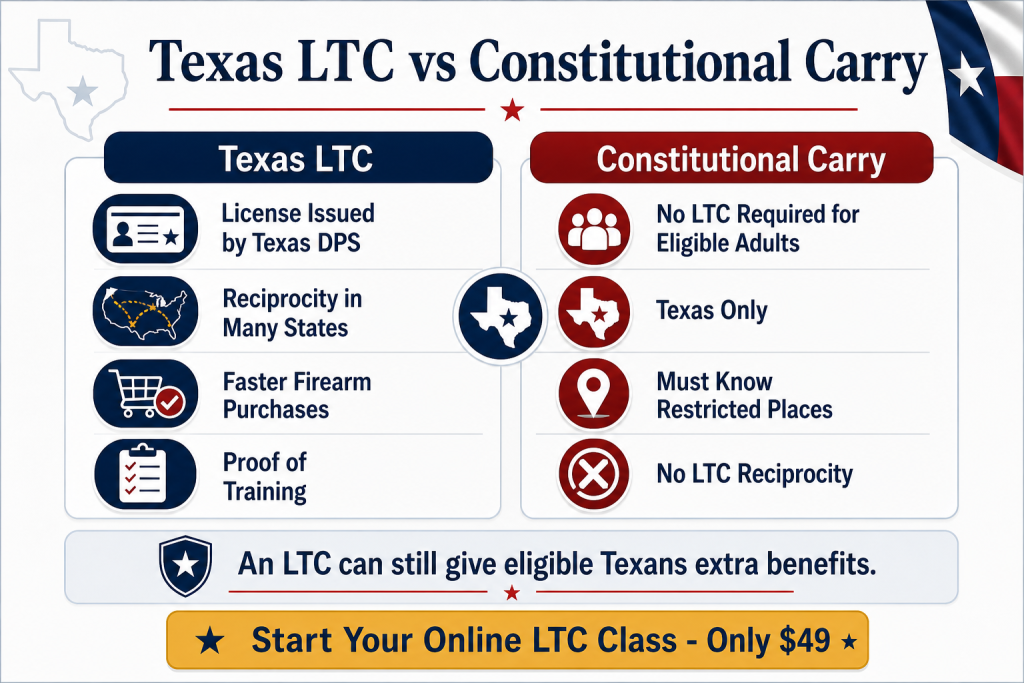
Texas LTC vs Constitutional Carry
Many Texans ask about Texas LTC vs constitutional carry because the law can be confusing. If Texas allows permitless carry, why would someone still get a License to Carry?
The simple answer is this: constitutional carry may allow many eligible people to carry without a license, but a Texas LTC still offers benefits that permitless carry does not.
This guide explains the difference between a Texas LTC and constitutional carry in plain language.
What Is a Texas LTC?
A Texas LTC, or License to Carry, is a handgun license issued by the Texas Department of Public Safety.
To get a Texas LTC, most applicants complete the state’s licensing process, which includes training, a handgun proficiency requirement, a DPS application, fingerprints, document submission, and background review.
After completing the required training, applicants receive the LTC-104 Form, which is submitted to Texas DPS as proof of training.
What Is Constitutional Carry in Texas?
Constitutional carry is commonly used to describe permitless carry. In Texas, permitless carry allows many eligible people to carry a handgun without first getting a Texas License to Carry.
Texas passed the Firearm Carry Act of 2021, also known as House Bill 1927. This law removed the license requirement for many people who can legally possess and carry a handgun.
However, permitless carry does not mean anyone can carry anywhere. You must still follow Texas law, federal law, location restrictions, and other rules.
Did Constitutional Carry End the Texas LTC Program?
No. Constitutional carry did not end the Texas LTC program.
Texas DPS states that permitless carry did not repeal the License to Carry Program. Texans can still apply for, renew, and benefit from having an LTC.
That is why many people still choose to get licensed even though Texas has permitless carry.
Main Difference Between Texas LTC and Constitutional Carry
The biggest difference is that a Texas LTC is a state-issued license, while constitutional carry allows qualifying people to carry without that license.
With constitutional carry, you may be able to carry in Texas if you are legally eligible.
With a Texas LTC, you have completed a formal process that includes training, proficiency, fingerprints, and background review. You also may receive benefits that unlicensed carry does not provide.
Texas LTC vs Constitutional Carry Comparison
| Topic | Texas LTC | Constitutional Carry |
|---|---|---|
| License required | Yes | No, for many eligible people |
| Training required | Yes | No state LTC training required |
| Range qualification | Yes | No |
| DPS application | Yes | No |
| Fingerprints | Yes | No |
| Background review | Yes, through DPS | No LTC background review |
| Reciprocity | May apply in other states | Does not give out-of-state reciprocity |
| Texas carry rules still apply | Yes | Yes |
Why Get a Texas LTC If Constitutional Carry Exists?
A Texas LTC can still be useful for several reasons.
Common benefits include:
- Reciprocity with states that recognize a Texas LTC
- Formal handgun safety training
- Better understanding of Texas carry laws
- Proof that you completed the licensing process
- Confidence when carrying in public
- A clearer credential when questions come up
- Possible convenience during firearm purchases
For many people, the value of an LTC is not only legal permission. It is preparation.
Reciprocity Is a Major Difference
One of the biggest differences between Texas LTC and constitutional carry is reciprocity.
Permitless carry is based on Texas law. It does not automatically allow you to carry in another state.
A Texas LTC may be recognized by other states through reciprocity agreements or state laws. If you travel, this can be an important reason to get licensed.
Before carrying outside Texas, always check the laws of the state you are visiting.
Training Is Another Big Difference
Constitutional carry does not require a person to complete the Texas LTC training course.
A Texas LTC does.
That training can help you understand:
- Use of force
- Deadly force
- Safe storage
- Prohibited locations
- Texas carry laws
- Legal signage
- Conflict avoidance
- Safe handgun handling
Carrying a handgun is serious. Training can help you avoid dangerous mistakes.
Does an LTC Let You Ignore Carry Restrictions?
No. A Texas LTC does not allow you to carry anywhere you want.
License holders must still follow state law, federal law, posted signs, school restrictions, court restrictions, secure area rules, and other limits.
An LTC provides benefits, but it does not erase every restriction.
Which One Is Better?
It depends on your goals.
Constitutional carry may be enough if you only want to know whether Texas law allows you to carry without a license and you are legally eligible.
A Texas LTC may be better if you want training, reciprocity, proof of licensing, and more confidence when carrying.
For many responsible gun owners, the better choice is to get the LTC even if it is not always required.
How to Get a Texas LTC
To get your Texas LTC, most applicants need to:
- Confirm eligibility
- Complete approved LTC training
- Pass the handgun proficiency requirement
- Receive the LTC-104 Form
- Submit the DPS application
- Complete fingerprints
- Upload required documents
- Wait for DPS approval
Once approved, DPS issues the License to Carry.
Final Thoughts
Texas LTC and constitutional carry are not the same thing.
Constitutional carry may allow many eligible people to carry without a license in Texas. A Texas LTC gives you a state-issued license, formal training, proof of completion, and potential reciprocity benefits.
If you want to carry responsibly and confidently, getting a Texas LTC is still a strong choice.
Get your Texas LTC Started Today!